 Laravel Magazine
Laracon US 2026: A Complete Wrap Up
Laracon US came back for its 2026 edition on July 28 and 29, at the SoWa Power Station in Boston's arts district. Two days, one stage, and a lineup of eighteen speakers that ranged from Taylor Otwell himself down to independent educators, package authors, and engineers visiting from outside the Laravel world entirely. If you couldn't make it to Boston, or you were there and want the announcements in one place without re-watching eight hours of stream, here's what actually happened on stage.
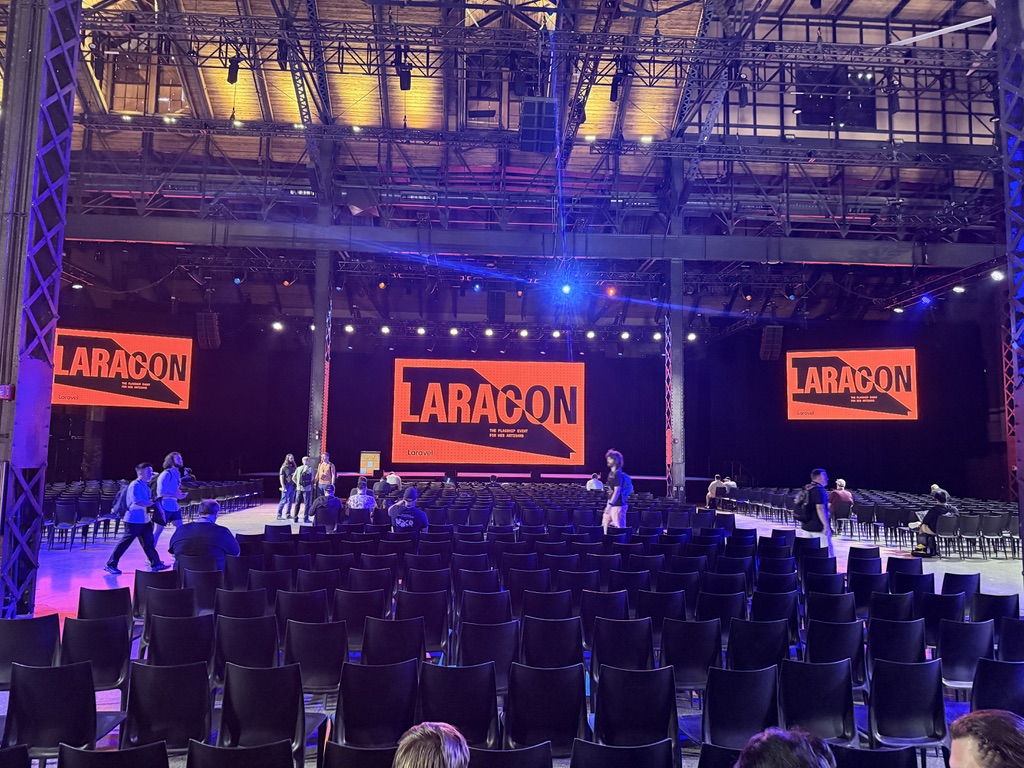
In typical fashion, the venue itself was a standout. I've always been a fan of the venues Taylor chooses to host Laracon, and the SoWa Power Station is no exception. With its very industrial look and feel, and three large screens, there wasn't a bad seat in the house, provided you could find a seat. It was a pretty packed conference.
Day one: the talks before the keynote
Day one opened with Aaron Francis, who's become something of a house host for Laracon at this point, and moved quickly into Nuno Maduro's unveiling of Pest 5. Maduro, who created Pest and sits on the Laravel core team, spent his slot walking through six new features, but the one that got the room's attention was the Tia engine (Test Impact Analysis). He described a personal suite that was taking 200 seconds, about three minutes, to run locally, and how that number balloons once AI agents start running the suite in a loop while you work. Tia fixes that by recording which tests touch which files on the first run, then only re-executing the tests a change actually affected and replaying cached results for everything else, coverage numbers included. Laravel later put a real figure on it: Laravel Cloud's own suite of over 19,000 tests went from three minutes to five seconds.
Pest 5 also ships an Agent plugin that gives coding agents a single command to verify a change against your real test suite (factories, RefreshDatabase, and all), an Evals plugin for scoring LLM output with both deterministic checks and LLM-as-judge scorers, first-party PHPStan and Rector support, and eight new expectations for things like email addresses, ULIDs, and IP addresses. It requires PHP 8.4 and PHPUnit 13.
From there the day moved through a run of talks less about announcements and more about how people actually build things. Kitze, founder of Sizzy, argued for what he's calling "vibe engineering" as distinct from vibe coding: using agents for nearly everything but staying close enough to the code that you'd notice if it went sideways, versus handing off a feature and finding out about the bugs secondhand. Mary Perry followed with "Cleverness Is a Loan," making the case that clever code is a form of technical debt you take out against your future self, or whoever inherits the code next. Later in the day, Laravel infrastructure engineer Chris Fidao gave "The Desired State," a look at how Laravel Cloud actually runs thousands of applications by reconciling toward a declared target state, the same idea Kubernetes is built on. Matt Stauffer of Tighten closed out the framework-adjacent talks with "Building Software at the Edge of Your Understanding," making a case for building past your comfort zone deliberately while still taking ownership of the result.
Rounding out day one were Freek Van der Herten on package-building patterns he's refined over years of Spatie's open-source work, Mateus Guimarães walking through building a CLI coding agent from scratch, Joshua Alphonse of Mux on building a video processing pipeline with Laravel queues, and Christina Martinez of Resend on what she calls whimsy-driven development. None of these were product announcements, but they're the kind of talks that make Laracon worth attending in person instead of just reading the release notes later.
The big one: Taylor Otwell's keynote
The last hour of day one belonged to Taylor Otwell, and this is where nearly everything you've likely already seen headlines about got announced.
Laravel LSP. The Laravel VS Code extension has quietly been one of the most useful tools in a Laravel developer's setup, autocomplete for routes, views, config keys, translation strings, middleware, and more. That intelligence lived in one extension for one editor, until now. Laravel LSP is a first-party Language Server Protocol implementation, so any editor that speaks LSP, including Neovim, Zed, Sublime Text, Cursor, and OpenCode, gets the same completions, hovers, diagnostics, and go-to-definition VS Code users already had. Install it globally with composer global require laravel/lsp (PHP 8.2+ required); Sublime, Zed, and VS Code have official extensions that wire it up automatically, while Neovim and OpenCode need a short config snippet.
This was a personal standout of mine. As a Nvim user, LSPs have really leveled up my loved terminal editor. With the introduction of a language server, it was one of the first things I did when I got back to my computer: get this installed. I can't wait to run it through its pieces.
CPX 2.0. Node developers have had npx for years. PHP developers had nothing quite like it until Taylor pulled a dormant open-source project by community member Liam Hammett called CPX and rebuilt it as a first-party laravel/cpx package. Run cpx laravel/pint and Pint executes against your project without ever touching your composer.json. Version 2.0 prefers your project's own locally pinned binary when one exists, falling back to an isolated install only when it doesn't, and you define your own aliases now rather than relying on a fixed list. It also handles running raw PHP files, GitHub Gists, and a REPL, and detects when it's being driven by an AI agent so it can return clean JSON instead of interactive prompts.
I remembered when this project was first introduced and thought that it potentially had legs. In the node world, they had been using npx for a while, and it seemed like a good solution. cpx never really did take off in the PHP world, and honestly, I had forgotten about it. I was really excited to see when Taylor mentioned that Laravel was going to take over the project. You have to have an expectation that, right off the bat, the Laravel team has some ideas of how they'd like to use cpx, and in my opinion, cpx is, in most cases, a better solution than doing composer global require.
Inertia DevTools. A Chrome extension, similar in spirit to Vue DevTools, that shows you every request your Inertia app makes, how headers are set, and exactly which props hydrated on a given page. Anyone who's spent twenty minutes in the network tab trying to figure out why a prop isn't showing up will appreciate this one.
Artisan dev, Blade support in Pint, and Artisan Doctor. The artisan dev command replaces the old composer dev wrapper around npx concurrently, moving process registration into a service provider so packages like Reverb or Horizon can register their own dev processes automatically. Pint now formats Blade templates with the same zero-config approach it's always applied to PHP. And artisan doctor runs health checks against your app, missing APP_KEY, PHP version mismatches, missing extensions, incomplete environment config, fixing what it can and telling you plainly what it can't. Packages can register their own checks, and it doubles as a sane last step for an AI agent to run before calling a task finished.
Other framework additions included a fluent image manipulation API for resizing, format conversion, and pixel-ratio handling without a separate library; a Laravel package skeleton GitHub template with an interactive setup script; a head tag API for managing everything between your <head> tags from PHP instead of scattered Blade partials; refreshable locks that let a long-running job extend a lock with $lock->refresh() instead of choosing between too-short and too-long up front; debounced jobs that collapse repeated dispatches into a single run; and a new container binding syntax that lets you declare a binding next to the implementation it describes.
Laravel AI SDK. The headline addition is human-in-the-loop tool approval: until now, an agent built on the AI SDK ran fully on autopilot once it started calling tools. The new HITL API lets you intercept specific actions and require a decision, approve, deny, or modify, before the agent proceeds. Alongside it: built-in filesystem tools so agents can read and write files without you building that integration yourself, a Str::summarize() helper that picks the cheapest available model by default, multimodal embeddings for images and audio (not just text, with automatic caching), support for Boost inferring your project's actual conventions and journaling its decisions as it works, and support for any OpenAI-compatible provider rather than just OpenAI.
Laravel Cloud. Since launching in February 2025, Cloud has added managed Reverb WebSocket clusters, a Redis-compatible Valkey cache, a REST API and CLI, and configurable spending limits. New this year: managed queues that run on isolated compute, scale to zero when empty, and now wake idle workers in under a second (down from about 30), plus FIFO ordering and jobs up to an hour long on the Pro class. Scale-to-zero itself got a ground-up rebuild called Flex compute, sleeping and waking an entire stack (compute, database, and cache together) in under 500 milliseconds, about twenty times faster than the roughly 10-second cold start it replaces. That capability, previously Postgres-only, now covers MySQL as well. A new secrets manager lets teams define a credential once at the organization level and push it to every linked environment, encrypted client-side before it ever reaches Cloud's servers. And Cloud can now deploy a Next.js or Nuxt frontend from the same monorepo as your Laravel backend, each with its own environment variables and domain but a single bill. Private Cloud, the fully isolated infrastructure option, is now HIPAA-certified alongside its existing SOC 2 Type II, GDPR, and PCI-DSS compliance, and customers can install extra software into their build image through add-ons instead of maintaining a custom Dockerfile.
Day two: more talks, then a community check-in
Day two opened light on framework news and heavy on ideas. Kent C. Dodds gave "The Last Software Engineer," an argument, opened memorably with a round of forced audience calisthenics, for the durable human skills that matter regardless of how much of the coding itself gets automated. Joe Tannenbaum walked through building real-time collaborative applications with Laravel. Pauline Vos of MongoDB introduced JJ (Jujutsu), a Git-compatible version control tool built around a different mental model, one where your working changes are just another commit you can reshape freely, and one that sits directly on top of an existing Git repo's storage without requiring your team to switch first.
Povilas Korop of Laravel Daily gave a practical, example-driven talk on advanced Filament usage. Gordon Diggs, an engineering manager at Stripe, spoke on building for agents and humans at once. Thorsten Ball, co-founder of Amp, gave "Think Harder: How I Prompt," a talk on prompting coding agents that, true to its billing, turned out to be refreshingly unglamorous: no MCP servers, nothing exotic, mostly discipline. Will King of Snowflake closed the AI-adjacent talks with "AI Can Do Your Job... What Now?", reframing the job that's actually at risk. Not lines of code, he argued, but the creative decisions about what's worth building in the first place. Devon Garbalosa, a solutions engineer at Laravel, gave a talk on scaling Laravel applications in production.
Mid-afternoon, the team paused for a Laravel Community Update, and the numbers were worth sitting through the transition slides for: 1,776 pull requests merged into the framework's own repository this year, plus 3,242 across the rest of Laravel's open source projects and documentation, more than 5,000 combined, with 270 of those contributors submitting their first-ever pull request to the project. The day, and the conference, wrapped with a closing panel.
What it adds up to
Strip away the individual features and a pattern shows up: Laravel is investing as much in the space around the framework, your editor, your test suite, your deploy pipeline, your AI agent's leash, as it is in the framework itself. LSP and Inertia DevTools are about the editing experience. Pest 5's Tia engine and agent tooling are about making a fast feedback loop possible even as agents run your suite far more often than a human would. The AI SDK's human-in-the-loop API and Cloud's secrets manager and Private Cloud compliance work are about giving teams the guardrails they need to actually trust automation with real infrastructure and real customer data. None of it fits in a single upgrade guide, but taken together it's a fairly clear statement about where the framework is headed next.
If you want to go deeper on any single piece, Laravel's own recap post covers every framework and Cloud announcement, and Laravel News has dedicated write-ups on Laravel LSP, CPX 2.0, and Pest 5 with full command references for each.
Sources:
- Everything we announced at Laracon US 2026 (Laravel)
- Laravel LSP: A First-Party Language Server (Laravel News)
- CPX: The Composer Package Executor for PHP (Laravel News)
- Pest 5 Released (Laravel News)
- Everything Announced at Laracon US 2026: Laravel, AI, and Cloud Updates (qadrLabs)
- Laracon US 2026: All Laravel & Cloud Announcements (Mohamed Said)
- The official Laracon US 2026 speaker lineup and schedule, along with the Day 1 and Day 2 Laracon US 2026 livestream transcripts